To deliver the best scans in the world at the fastest speeds with the highest quality, you need to make certain scanner requirements fit together and work in concert.
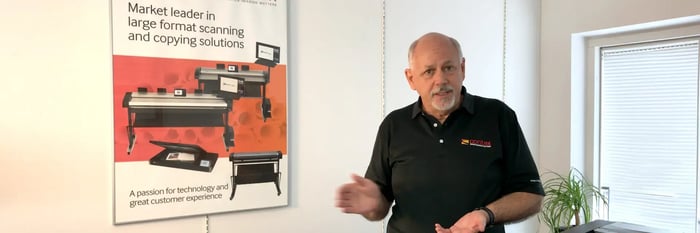
In the videos below, Contex’s Director of Support Services, Dan Bennett, presents the four requirements that are crucial to the success of any large format scanning process:
- Hardware design (1:54)
- Software options (2:44)
- Productivity and flexibility (1:31)
- Image quality (2:41)
Under each video, you’ll find the key points from our report on the same topic.
1. Hardware design: why it matters
Many design features built into a Contex scanner may not be noticeable at first glance. However, once you put the scanner to use, together they make all the difference between a good and a bad scanning experience.
The top five features are:
- An ample table surface eases the handling of large documents.
- Large-capacity input buffers allow operators to scan one document after the next without ever experiencing a delay or lag time.
- The highest-quality camera lenses and scanning technology make it possible to capture every detail in perfect color.
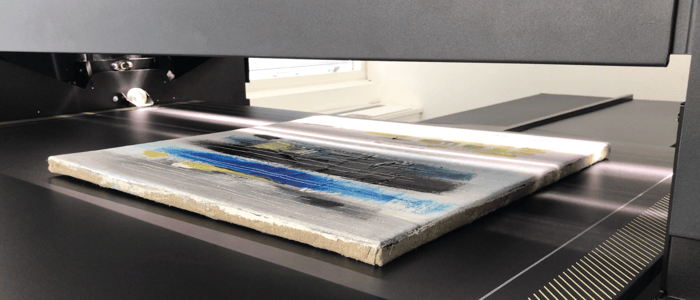
- Guide plate options let operators scan any type of document: thick, thin, rigid, or pliable.
- A simple and intuitive interface allows even the newest of operators to feel confident when they walk up to the scanner.
2. Software options: why it matters
Good scanning software is paramount. It can create a workflow that makes the scanner faster and easier to use, and, most importantly, it can provide an image that more often is better than the original.
Nextimage includes a range of tools to optimize results for every use. If productivity is a priority, batch scanning makes it easy to insert one document after the next and focus on paper handling. Nextimage will also automatically name, rotate, adjust image quality and remove background noise from the images. The operator simply inserts one document after the next, with no need to touch the PC or even a touch screen.
If printing scanned images is required, Nextimage supports a large number of large format printers and comes with an advanced color calibration wizard. The wizard lets operators print a color target, scan it, and get a color match between the printer and the scanner, with no color experience needed.
3. Productivity and flexibility: why it matters
Productivity and flexibility go hand in hand. To be productive, the scanner must be flexible and conform to your specialized workflows without interruption. It really comes down to how many finished and stored scans can be produced in an hour.
When a document exits a Contex scanner, it is immediately ready for another one. There is no fumbling with the mouse or touch screen and no need to wait for the scanner to process the image. In batch mode, all your attention can be focused on preparing and inserting the next document. The highest mechanical speed does not always equal the highest productivity. Shifting from one style of workflow to another is as simple as selecting a personalized software preset.
4. Image quality: why it matters
Scanner image quality and accuracy are the result of designing and combining the right hardware and software technology. Contex develops both CCD and CIS scanning technologies with this goal in mind.
CCD and CIS scanners
CCD scanners
CCD scanners use high-end optic lenses that capture extremely accurate detail in high resolution and with deep focal length. This provides flexibility to scan a diverse array of document types:
- Rigid documents that may not lay flat against the glass plate are no problem. CCD technology keeps everything in focus and captures full color depth.
- Black and white maps, GIS documents and color photos are all captured with equal precision.
- Color, grey or monochrome are captured using high-end CCDs and image processing.
Read our CCD scanner guide
CIS scanners
CIS scanners use high-end contact image sensors that capture accurate detail in high resolution and 48-bit color, so both monochrome and color documents can be scanned precisely and inexpensively.
Highest quality is obtained with documents that are not rigid, heavily folded or wrinkled, and lay flat against the glass. Dual LED sensors provide additional lighting from two angles to help with folded or wrinkled documents. The lighting is typically brighter in a CIS module, so an application such as Nextimage is important to manage the extra contrast.
Read our CIS scanner guide
Is a scanner just a scanner?
Absolutely not. Regardless of the scanning technology, image quality is not an area to cut corners. Contex scanners are developed through real-life experience where efficiency, ease of use and quality are of utmost importance, and are supported by distributors worldwide.